April 2026
The Maya of Southern Belize
Fierce heat from above and in front. Standing this close to a fire with the Belizean sun near its zenith was unpleasant; worse for those who were closer tending the flame, the black smoke billowing into their eyes, mingling with stinging sweat and causing them to wince through their words. For they were all speaking; words of prayer, of which we could understand little but for some repeated phrases alluding to the landscape. Their clothing was colourful, patterns abundant from their long skirts up to the fabric fashioned into headdresses.
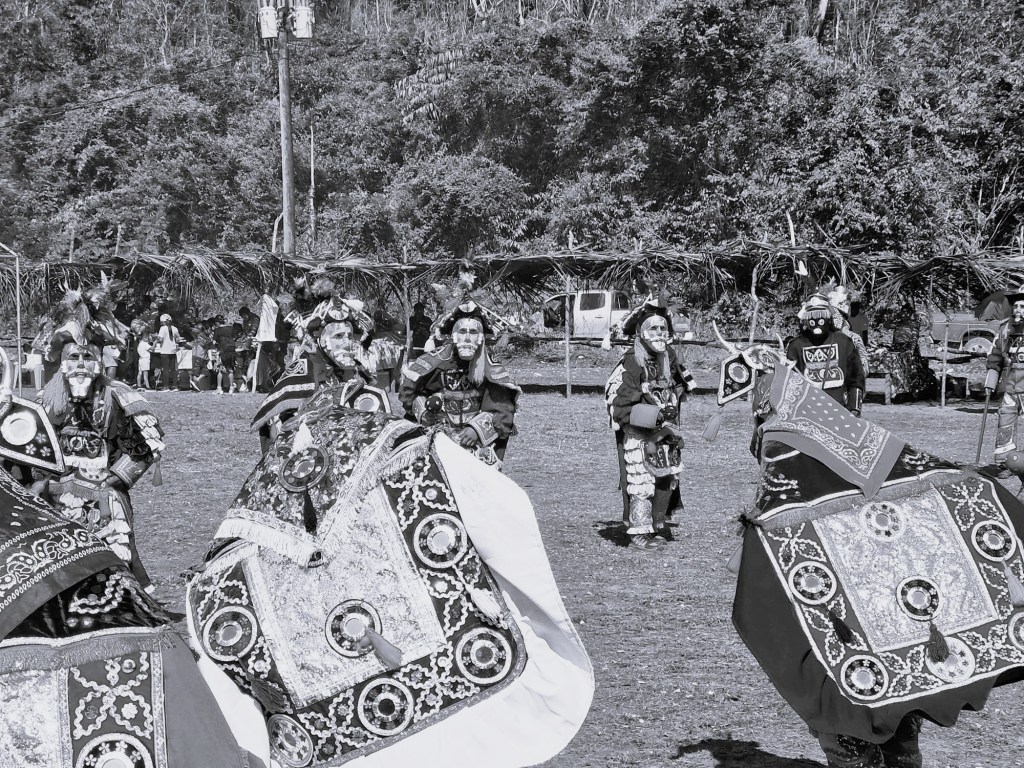
They threw hundreds of small, scented candles into the fire as they spoke, sustaining the fragrant flames. A ring of leaves stuck upright into the earth surrounded those praying, beyond which stood the crowd we were a part of. Behind us, dancers donned with dazzling cloaks, faces hidden beneath the carved caricatures of deer and 16 th century Spaniards, twirled to the light-hearted rhythm of marimba music. The field itself was lined with pole- and-palm-leaf structures, separated into rectangular stalls for selling local goods. Many of them sold caldo, local meat stewed in herbs found in village gardens, and served with corn flattened into a tortilla, or boiled into poch. The smell of roasting meat carried across the field on whisps of steam and smoke.
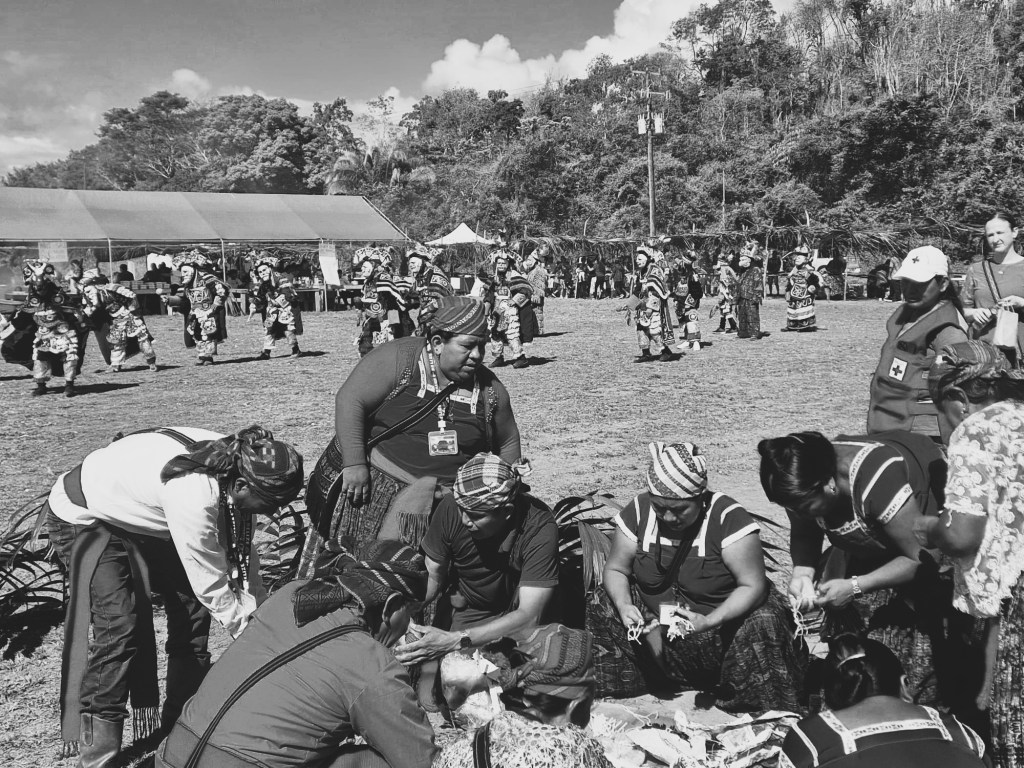
This was the opening ceremony of the annual ‘Maya Day’ of Toledo district. A celebration of all that is Maya, it seems as good a place as you might ask for to begin to explain that population to the people of Chew Valley. And that assumption was held by those of high repute; before the day was over, we had the pleasure of meeting the preeminent presenter Dan Snow, filming for an upcoming documentary on the same topic. We complemented his filmmaking; he complemented the cultural combination of an England Cricket hat with a traditionally embroidered Maya shirt.
But we have an advantage over Mr Snow. Whilst his familiarisation with these people relied on a short window in his busy schedule, the duration of our stay and the nature of our work allows us a different insight. We are lucky enough to work alongside Maya people, be invited to their villages, learn their languages, and be a part of their everyday life. We are lucky enough to call some of them our friends.
The Maya of southern Belize are comprised of two groups, distinguished linguistically as
‘Q’eqchi’’ and ‘Mopan’. The Mopan speakers originally occupied an area around what is now central Belize and west of its border with Guatemala. They were forced by the Spanish into a much smaller range, part of the process of making more manageable the colonial administration. The Q’eqchi’ language, however, originated in highland Guatemala. At the time of contact with Spain in the 16 th -century, their region was known as ‘the land of war’; they were considered a formidable people, fortified by the landscape and their disapproval of foreign intervention. It is Bartolome de las Casas who is credited with seeing an opportunity in this, persuading the Q’eqchi’ to convert to Christianity, whilst agreeing that no foreigners without religious purpose should enter Q’eqchi’ territory. Over the following centuries, many Q’eqchi’ would move north and eastwards, escaping oppression and servitude as their land was gradually appropriated, and first settling in the south of what would become today’s Belize around the turn of the twentieth century.
The Q’eqchi’ and Mopan have different histories, but it is unusual here to meet someone who does not have heritage of both. Despite this, being ‘Mopan’ or ‘Q’eqchi’’ is an important part of a village’s identity. And if you know where to look, there are other differences beyond thelanguage, like preferences for certain ways of cooking, or variations in stitch patterns on clothing. But it is fair to say that a large part of their culture is shared, such that the Maya of
southern Belize might be spoken about as a collection of individual villages that form a cultural unit.
In fact, it is in this way, as ‘the Maya of southern Belize’, that they are termed on a piece of incredibly important policy. This policy upholds the rights of the Maya people to use their lands as they have done customarily, and inhibits external influence from impacting those lands without consent of the people who live there. The Maya have fought for this recognition of their lands to stop the processes of displacement and outside control that have characterised their history since European contact, because they do not own or use land in the same way as might the people of Somerset. It is easy enough from the outside to agree that they should have rights to the areas that they have maintained for generations; but to understand how crucial those rights really are, it is necessary to experience the way in which they relate to their land.
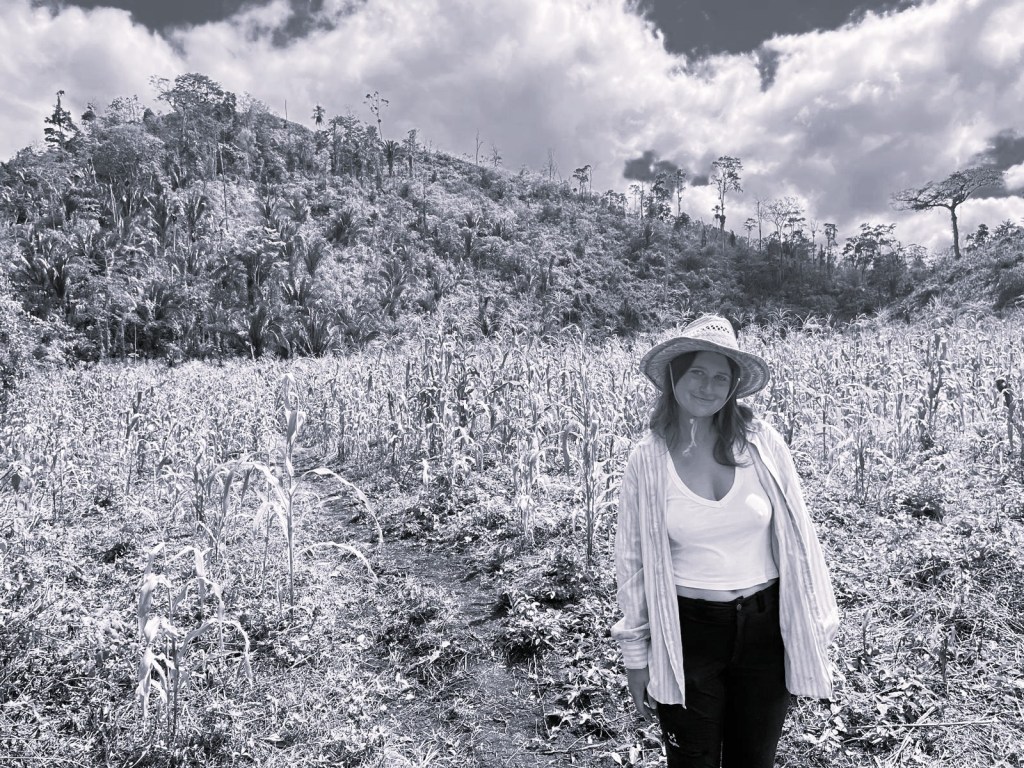
Sunlight dappled the path we walked upon through the dense canopy, making for a fine Sunday afternoon in the jungle of Toledo. Two young children ran ahead, brandishing a machete that glinted as it rose in its arc, falling again to clear any unwanted vegetation. Their parents walked just in front of us, chatting casually as we twisted along the earthen track, occasionally choosing a direction at a junction of multiple possibilities. Beside our path, the trees were dense; noises emanated from within, sometimes cheerful birdsong, sometimes unknown and eery. Some half an hour’s walk from the road, we stepped over a large fallen trunk blackened from a recent fire, the trees fell away either side, and an open landscape
emerged. A field had been carved into the uneven terrain, stretching towards a rocky outcrop to our left, and steepening up the side of a hill at the furthest extent to our front, where the rich trees of high jungle resumed. This was the primary farm of the family, and we had come to harvest some produce for our tea.
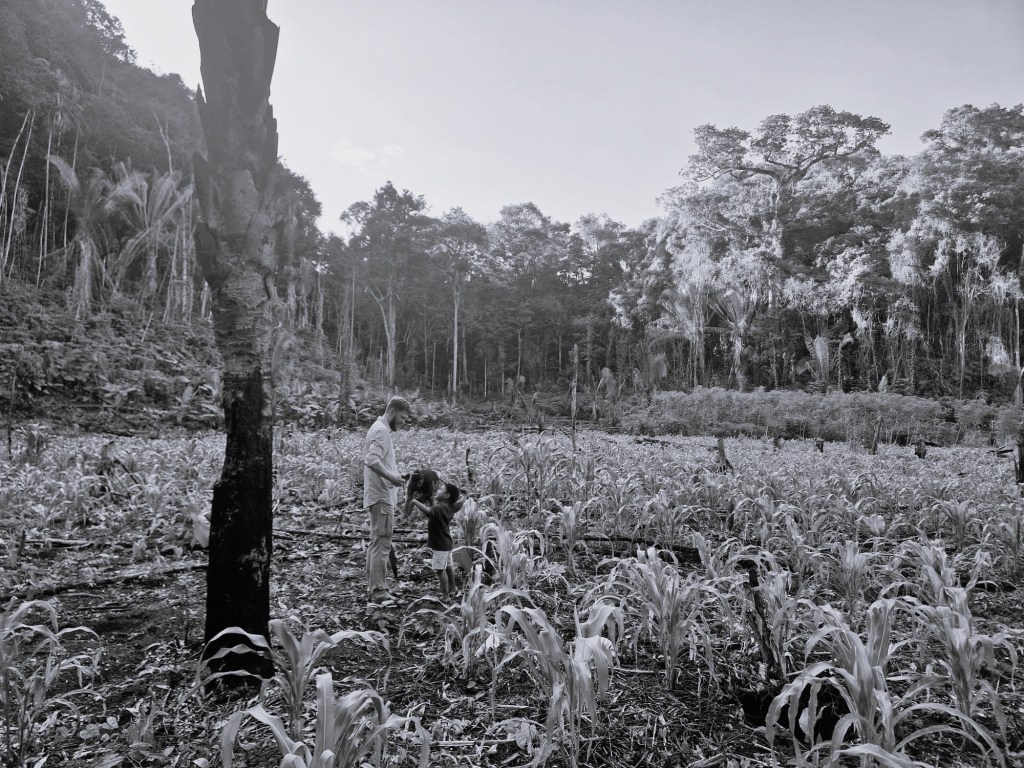
This land was passed down to our friend through his father. A common misconception is that
the communal land system of the Maya means that land is not held by specific families. In fact, it will be theirs for as long as they are a part of the community, passed through
generations. But the land cannot be sold privately, because it belongs to the village. This is only one parcel of land that the family uses; others lie similarly in the jungle, but it would be hopeless for us to find them, because the farmland is periodically left to rejuvenate secondary forest over a period of years. Last year, this farm would also have been secondary growth.
After a tiring process of chopping the forest, the residue had been burned, allowing for planting in the soil and ash below. This is often thought of as poor practice, by those who see only the destruction of what they believe is virgin forest; in reality, allowing for forest to
reclaim farmland provides a habitat for flora and fauna, whilst providing better nutrients in which to grow the family’s food. Shifting cultivation of this type is by no means random, either; the farmer plans far in advance how best to manage the lands that they responsible for, respecting and reproducing the equilibrium between the ecosystem and village.
As we returned home, our vibrantly adorned hand-sewn bags full of tomatoes, coriander, onions, jalapenos, cassava, ginger, and more (plants for which English names are not readily available, we suspect), we saw first-hand why maintaining the equilibrium with the forest is important for the community. Our stroll was punctuated with demonstrations of attaining edible products from the forest. By cracking nuts, skinning branches, or chopping trees to cut out the ‘heart’ of the trunk, more food was added to our collection; and at other stages, we would assess prints and rock formations where an animal might reside. Reading these signs in
the daylight helps the hunter plan a route, but it is not until the moon has set that meat could be added to the menu.
A different night found us walking once again with trees closing on either side, this time the darkness heightening our senses to each cracking twig or shifting leaf half caught in our circle of torchlight. Once we reached our destination, we found ourselves on the edge of a
thick black ribbon of water. A crescent moon backlit the forest on the far bank, casting a quivering account of its treetop contours ghost-like onto the river. But it was not the water’s surface with which we had business. We submerged ourselves, sliding cautiously on rock
formations unseen, until it was possible to swim. We had in our hands a steel rod, sharpened to a point at one end, thick elastic bands attached to the other. These bands were looped around our fingers, pulled taught such that the steel could be launched by aiming and
releasing when a fish was sighted. In this way we plunged to search the rocky crevices, fish fleeing our cumbersome aquatic style with ease. Surfacing for breath, however, we watched our guides triumphantly pulling prey from their weapon to hang upon their belt with regularity. The following morning we were treated to fish breakfast. Fish is often wrapped in
a large leaf with a variety of spices and steamed over the hearth, a style called lancha. The popularity of this food proves the abundance of the watersheds, free for all villagers to utilise.
But it is maize that underpins the diet here, with cornfields the predominant landscape use aside from jungle. Corn is stacked high along the wall of every house, and many everyday tasks – from the men harvest, bagging, and hauling to the homes, to the women husking, washing, and milling – revolve around this staple food source. Farming of this plant is
ritualised; whilst the specific activities the farmer takes will vary, prayer offered to the landscape is before planting is routine. It is the landscape, or rather the personification thereof, to which those at Maya Day were directing their words. Traditionally, this
personification is responsible not only for the crop, but also the animals upon the landscape, and the weather that sustains them all. These beings (the name of which translates to ‘hill- and-valley’ in Q’eqchi) are the landscape itself, but are sometimes embodied by taking the form of an old man and residing in caves (a word which, in turn, translates into ‘stone house’). However, since the conversion of many Maya peoples to Christianity, God now often forms a part of the prayer in a syncretised faith.
The planting of corn is completed communally, as is the felling of trees that facilitates it. This
custom has interesting repercussions for sustainability, because the amount of land a farmer uses depends partially on the amount of labour he can acquire. Whilst the community can
monitor an individual’s land use, by withholding their own time if they deem it necessary, this would only happen where a farmer attempts to clear more land than is required for their family. Planting is jovial event; after the prayers, whilst holes are pushed into the earth with sharp sticks and corn thrown in, stories and jokes are shared between the party. And upon the
return home, a meal is served to all helpers where the festivities continue.
A similar style of community engagement characterises the governance systems of these villages. The Alcalde of a village is elected every two years to serve as a mediator, but contrary to the common misunderstandings of outsiders who might perceive them as some form of ‘chief’, they are mandated only to act as representative of the community and execute its wishes. When a decision must be made, if it will affect communally held lands or the future of the community, a village meeting will be called. All members of the village will be
invited, and traditionally the session is heralded by three blasts on a horn made from a conch
shell. The right to voice an opinion at this meeting, to have a direct impact on how one would like to see their own future, is an important part of village life. This form of governance is upheld by the aforementioned policy, protecting the Maya’s rights to political interaction at the village level.
The villages themselves are a lesson in tranquillity. Walking at sunrise, the new light of day
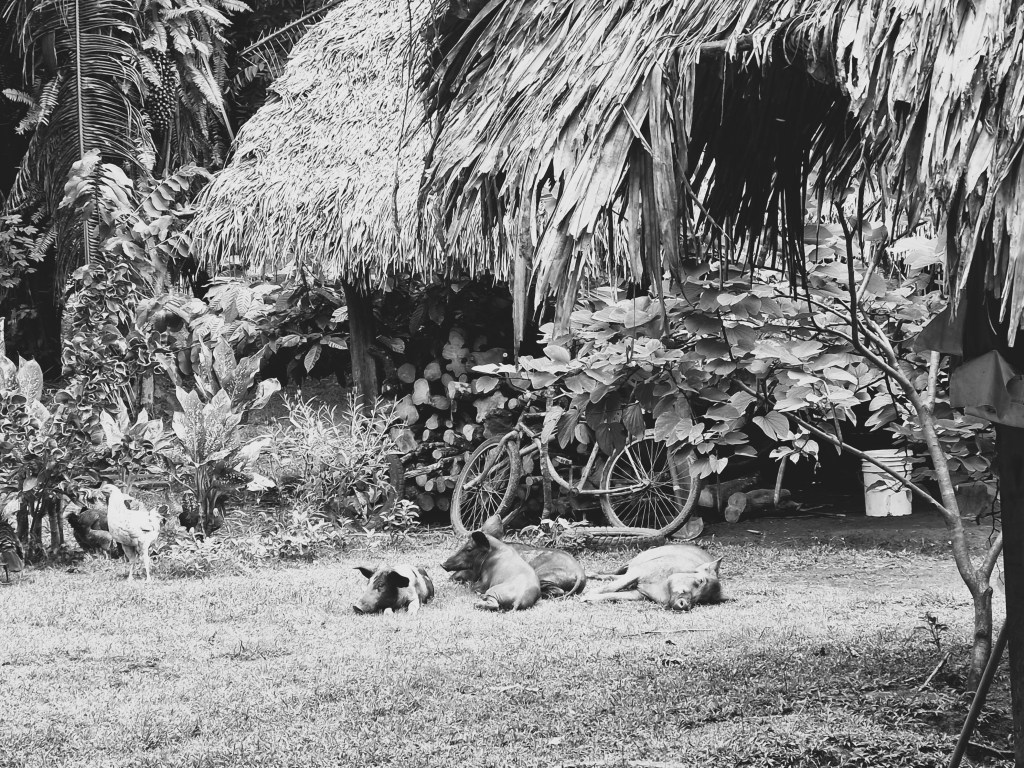
layered in pastille purples and fading turquoise, the smoke of freshly lit fires lifts slowly up from the long houses of plank walls and thatched roofs. Listening to the waking chorus of birdsong all around, watching chickens lazily scratching at earth, as dogs sleep soundly beneath the fruit trees, it is easy to appreciate the peaceful life that the villagers enjoy. Later in the day, there is more activity. It is common to hear the radio on, or music playing from a phone as women wash pots and clothes in crystal-coloured creeks; men conversing on their way to the farm, or building in blockwork next to the road; a motorbike carrying a family towards town; children singing in the tin-roofed church. But never the pulse-raising rhythms of life so freely found in the cities and towns we are more used to.
What is written about the Maya is so often tinged with problematic labelling. From the colonisation of their landscape, the exploration of their temples, and descriptions of their lifestyle, it is common to hear a simplified narrative; that the Maya were an enlightened,
astronomical, and city-building people, that they reached a period of collapse, and were found by Europeans living as a shadow of their former societies.
But it seems to us that there is no ‘regression’ about this lifestyle at all. More equitable distribution of land and resources, a genuine avenue for political interaction for all individuals, a landscape-level reciprocity that allows a flourishing ecology near their villages… in fact, are there lessons here for the villages of Chew Valley? When you are fortunate enough to understand the way of life, you realise that the
Maya make a choice to create and maintain the serenity with which they live. Maya Day was an experience we were grateful to be a part of. But no culture can be distilled into a singular event, and nor can it be done justice in an article such as this. The Maya of
southern Belize, as all peoples, are made up of individuals with different histories, desires, beliefs and customs, tastes in music and food, levels of education, and support for football teams. We have done our best to describe some of their culture through our experiences here.
Let’s wait and see what Dan Snow makes of them.


Leave a Reply